
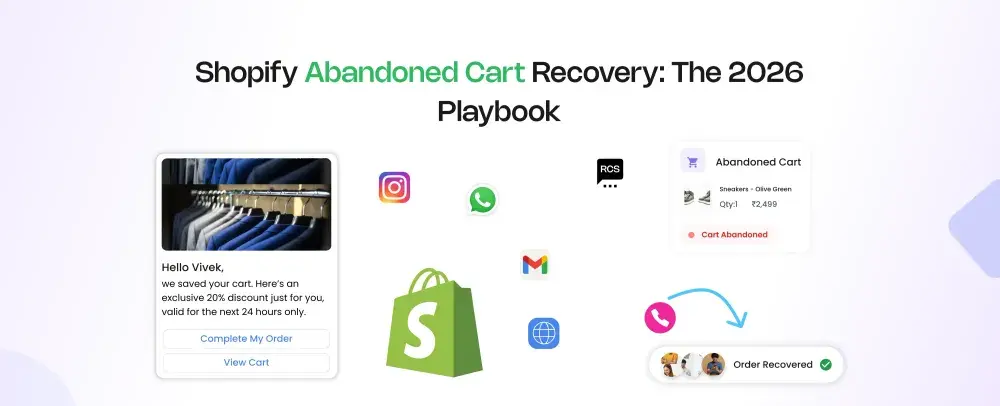
Shopify Abandoned Cart Recovery: The 2026 Playbook
Reducing cart abandonment is one problem. Recovering the carts that already left is another. This is the complete 2026 playbook for winning back lost Shopify sales through WhatsApp, email, SMS, and multi-channel recovery flows that actually convert.
You spent money getting a shopper to your store. They browsed, picked something out, added it to their cart and then disappeared.
That's not a fluke. It happens to roughly 7 out of every 10 carts on Shopify stores. And for most brands, those abandoned carts represent the single biggest recoverable revenue opportunity sitting untouched in their store.
The good news: most of that revenue isn't gone. It's just waiting for the right follow-up, at the right time, on the right channel.
This guide covers everything you need to build a proper Shopify abandoned cart recovery system in 2026 from Shopify's built-in tools to multi-channel flows that actually convert.
What Is Shopify Abandoned Cart Recovery?
Abandoned cart recovery is the process of re-engaging shoppers who added items to their cart but didn't complete the purchase. The goal is simple: bring them back and close the sale.
But before you set anything up, it helps to understand what you're actually recovering because "abandoned cart" and "abandoned checkout" aren't the same thing, and Shopify treats them differently.
Abandoned Cart vs. Abandoned Checkout
An Abandoned Cart happens when a shopper adds items to their cart but never reaches the checkout page. Shopify doesn't capture their contact details at this stage, so you can only reach them through on-site tactics like exit-intent popups or browser push notifications.
An Abandoned checkout happens when a shopper starts filling out their checkout entering their email address or phone number but doesn't place the order. This is where Shopify's native recovery emails kick in, because you now have a way to reach them.
In practice, the terms get used interchangeably. When most people say "cart recovery," they mean recovering both.
Why Shopify Stores Lose Sales at This Stage
Shoppers don't abandon carts randomly. There's almost always a reason and understanding those reasons is what separates a recovery system that converts from one that just sends emails into the void.
The most common drop-off points are:
- Unexpected costs appearing at checkout (shipping, taxes, fees)
- A checkout flow that feels slow, confusing, or asks for too much
- Doubt about the brand no reviews, no trust signals, no clear return policy
- Getting distracted mid-purchase and simply forgetting
- A mobile experience that's clunky or hard to navigate
Recovery fixes the symptom. Checkout optimization fixes the cause. A strong 2026 strategy does both.
What a Recovery System Should Actually Do
A recovery system isn't just an automated email. It should:
- Reach the shopper on the channel they're most likely to respond to
- Send the first message before they've mentally "moved on"
- Remind them of what they left behind with product details and images
- Address the likely reason they didn't buy (price, trust, urgency)
- Follow up more than once, without being annoying about it
If your current recovery setup is a single email that goes out 24 hours later, you're leaving most of that revenue on the table.
Why Cart Abandonment Matters in 2026
The Current Abandonment Rate Benchmark
The average cart abandonment rate across ecommerce sits between 70–75%, and it's been there for years. On mobile, it can climb higher closer to 80–85% depending on the category and checkout experience.
That number sounds alarming. But it also means that for every 100 people who add something to their cart, 70 didn't buy. That's 70 second chances.
Revenue Lost from Unfinished Checkouts
Let's put it in concrete terms. If your store does ₹20L/month in revenue and your abandonment rate is 70%, a rough estimate of abandoned cart value sits somewhere around ₹45–50L per month. Even recovering 10% of that adds ₹4–5L to your monthly revenue from traffic you've already paid for.
For Shopify brands running on thin margins, this isn't a nice-to-have. It's one of the highest-ROI levers available.
Why Recovery Is Cheaper Than Acquisition
Every rupee you spend recovering an abandoned cart is working on a customer who already showed buying intent. They found your store, liked what they saw enough to add it to their cart, and got as far as checkout. Compared to acquiring a brand-new customer who has never heard of you, doesn't trust you yet, and costs more to reach every quarter recovery is dramatically more efficient.
The math almost always favors fixing the leak before spending more to fill the bucket.
Common Reasons Shoppers Abandon Carts
Knowing *why* people abandon helps you write better recovery messages and, eventually, prevent more abandonment in the first place.
Unexpected Shipping Costs
This is the number one reason, consistently. A shopper sees a ₹499 product, gets to checkout, and discovers ₹150 in shipping fees. The perceived deal falls apart. The fix isn't always free shipping it's transparency. Show shipping costs earlier, and your recovery message can address it directly ("Free shipping on orders over ₹999 you're almost there").
Slow or Complicated Checkout
Every extra field, every required account creation, every redirect adds friction. Shopify's one-page checkout has helped here, but brands with custom checkout flows or multiple steps still see significant drop-off. If your checkout takes more than 2 minutes, you'll lose impatient shoppers.
Lack of Trust or Payment Options
A shopper who doesn't recognize your brand needs reassurance before handing over their card details. Missing trust signals no reviews, no return policy, no security badges kill conversions. So does a limited payment selection. In India particularly, not offering COD, UPI, or EMI options on higher-ticket products is a meaningful conversion barrier.
Distractions and Comparison Shopping
Sometimes the shopper simply got a WhatsApp message, switched tabs, or decided to check if the same product is cheaper somewhere else. These aren't "lost" customers they're undecided ones. A timely, well-crafted follow-up can be exactly what tips them back to your store.
Mobile Experience Issues
Mobile accounts for the majority of ecommerce traffic in India, but mobile checkout completion rates are significantly lower than desktop. Slow load times, difficult-to-tap buttons, and checkout forms that don't work well on smaller screens all contribute. A poor mobile experience means a higher recovery workload and a lower ceiling on what recovery can achieve.
Shopify's Built-In Recovery Tools
Before adding any third-party tool, it's worth understanding what Shopify gives you out of the box.
Automatic Abandoned Checkout Emails
Shopify natively sends abandoned checkout emails when a customer has entered their email address at checkout but hasn't completed the order. This is enabled by default for most Shopify plans. You can customize the email template under **Marketing > Automations** in your Shopify admin, and update the subject line, logo, and copy to match your brand.
Recovery Timing Options in Shopify
Shopify's default timing for the abandoned checkout email is **1 hour** after the cart is abandoned. You can adjust this in the automation settings. The available options are typically **1 hour, 6 hours, 10 hours, or 24 hours** after abandonment.
For most stores, 1 hour is the right first message. The shopper is still warm, still in purchase mode, and the reminder feels natural rather than intrusive.
Shopify Flow and Automation Use Cases
If you're on Shopify Plus, Shopify Flow gives you more control you can build multi-step logic around abandoned checkouts, trigger different messages based on cart value, tag high-intent customers, or connect to third-party apps as part of a broader sequence.
For brands not on Plus, Flow isn't available natively, but most recovery tools integrate with Shopify through the standard API.
Limits of Native Recovery
Shopify's built-in tools have real limitations:
- **One email, one channel.** No SMS, no WhatsApp, no push notifications natively.
- **No sequence.** One message, sent once no follow-up if the first email doesn't convert.
- **Limited personalization.** Basic product details and customer name, but no dynamic logic based on cart value, customer history, or segment.
- **No attribution dashboard.** You can see open rates, but not recovered revenue attributed to specific messages.
For early-stage stores, native tools are a starting point. For brands doing serious volume, they're not enough.
The Best Recovery Channels in 2026
A single-channel recovery strategy converts a fraction of what a multi-channel stack can. Here's how the main channels stack up.
Email Recovery Sequences
Email is the most common recovery channel and still works well especially for higher-value carts and customers who prefer longer consideration windows. A good email sequence has at least two messages: a reminder within the first hour, and a follow-up (often with a nudge or offer) 24–48 hours later if no purchase has been made.
Email works best when the cart value is high, the product requires more consideration, or the customer is already familiar with your brand.
SMS Recovery Flows
SMS gets read. Open rates are consistently 90%+, and response times are fast. A well-timed SMS sent 30–60 minutes after abandonment often outperforms email in raw recovery rate for impulse-friendly or mid-range cart values.
Keep SMS messages short, conversational, and direct. Include a clear link back to the cart. Don't over-automate two messages maximum before backing off.
WhatsApp Recovery
For Indian D2C brands, WhatsApp is often the highest-converting recovery channel. It feels like a personal message, not a marketing blast. Customers can reply and ask questions. You can include product images, cart links, and even offer to help directly.
The key difference between SMS and WhatsApp is interactivity a shopper who replies to a WhatsApp message is often just one question away from completing their order.
Browser Push Notifications
Push notifications can re-engage shoppers who didn't give you their email or phone number. They work only if the customer previously opted in to notifications on your site, which limits reach but for that segment, they're a fast, frictionless channel.
Best used as a first-touch recovery message for anonymous visitors, or as a supplement to email and SMS.
Retargeting Ads
Running retargeting ads on Meta or Google to people who abandoned checkout is a channel with a higher cost-per-recovery but broader reach. It works well for high-intent, high-value segments particularly when you can show the exact product they left behind.
Use retargeting as a layer in your recovery stack, not the primary channel. It's more expensive than a WhatsApp message, but it reaches shoppers who gave you no contact details.
On-Site Recovery When Customers Return
Sometimes a shopper comes back on their own but without any prompt to pick up where they left off. A persistent cart (Shopify does this by default), a checkout recovery banner, or a sticky "You left something behind" widget can quietly recover a sale with no messaging required.
How to Build a High-Converting Recovery Flow
The channel matters less than the sequence. Here's how to build one that consistently converts.
Timing Your First Message
Speed is the most underrated variable in recovery. The first message should go out within **30–60 minutes** of abandonment. At this point, the shopper is still thinking about the product. They haven't committed to not buying they got distracted, hesitated, or ran out of time.
Wait 24 hours, and you're fighting a much colder lead.
When to Offer a Discount
Not every recovery message needs a discount. In fact, offering one immediately trains your customers to abandon carts on purpose to wait for the code.
A better structure: the first message is a simple reminder with no offer. If they still haven't converted after 24 hours, the second message can introduce urgency limited stock, or a time-limited discount. This keeps your margins healthier and rewards genuine hesitancy rather than gaming behavior.
Personalization That Improves Conversion
At a minimum, every recovery message should include:
- The customer's first name
- The exact product(s) they left behind (with images in email/WhatsApp)
- A direct link back to their cart
Beyond the basics, personalization by cart value, product category, or customer history can significantly improve results. A first-time buyer needs more reassurance. A repeat customer needs less selling and more convenience.
Segmentation by Cart Value, Customer Type, and Device
High-value carts (above ₹2,000–3,000) justify a more personalized approach longer emails, a possible phone call or WhatsApp message from a real person, and a more meaningful offer if needed.
Low-value carts should be kept lightweight. A quick SMS or push notification is enough.
Device-based segmentation also matters. Mobile abandonments often need shorter messages and bigger CTA buttons. Desktop abandonments may respond better to a detailed email.
Multi-Step Flow Example
Here's a simple three-step recovery flow that works:
**Step 1 45 minutes after abandonment:** WhatsApp or SMS. Short, friendly, no offer. "Hey [Name], you left something in your cart. Here's your link: [link]"
**Step 2 24 hours later (if no purchase):** Email. Longer, with product images, a reminder of your return policy and trust signals. Optional: mention limited stock if true.
**Step 3 48–72 hours later (if still no purchase):** Email or WhatsApp. Introduce a time-sensitive offer a small discount or free shipping. This is the final nudge.
Stop the sequence the moment a purchase is made.
Best Practices for Abandoned Cart Emails
Subject Line Examples
The subject line determines whether the email gets opened. Keep it short, specific, and slightly personal:
- "You left something behind, [Name]"
- "Your cart is waiting and it's almost gone"
- "Did something go wrong at checkout?"
- "[Product name] is still in your cart"
- "Quick heads up before your cart expires"
Avoid generic lines like "Complete your purchase" or "Don't forget!" they signal mass automation and get ignored.
Message Length and Structure
Recovery emails don't need to be long. The structure that works:
1. Personal greeting
2. Product image(s) and name(s)
3. One-line reminder of what they left behind
4. Trust signal (return policy, reviews, delivery time)
5. Clear CTA button
That's it. If you're adding more than that, you're probably adding friction.
Cart Images and Product Reminders
Visual reminders work. An email that shows the exact product someone was considering with the right image, color, and size converts significantly better than one that just mentions the product name. Pull these dynamically from your Shopify product catalog.
CTA Placement and Urgency
One CTA, placed prominently, above the fold. Use action-oriented language: "Return to my cart" or "Complete my order" rather than "Click here" or "Shop now."
Urgency works when it's real. "Only 3 left in stock" is powerful but only if it's true. False urgency erodes trust fast.
Common Mistakes to Avoid
- Sending more than 3 recovery messages (it starts to feel like harassment)
- Offering a discount in the first message (trains abandonment behavior)
- Using a no-reply email address (makes the brand feel impersonal)
- Sending recovery messages to customers who already purchased (a tracking failure that damages trust)
- Identical copy across all messages in the sequence
SMS and WhatsApp Recovery Strategy
When SMS Works Best
SMS works best for short-consideration, mid-range cart values where the shopper just needs a nudge. It's fast, personal, and has near-universal open rates. For Indian customers especially, an SMS arriving within an hour of abandonment often feels like a helpful reminder rather than a marketing message.
Compliance and Consent Basics
In India, SMS marketing to customers requires opt-in consent under TRAI regulations, and WhatsApp Business messaging follows Meta's policies around user consent and opt-in. The practical takeaway: collect explicit consent at the point of purchase or sign-up, and only send recovery messages to customers who have opted in.
Message Templates That Feel Natural
The best recovery SMS and WhatsApp messages don't feel like marketing. They feel like a person typing.
SMS example:
"Hi [Name], your [Product] is still in your cart. Complete your order here: [link] Reply STOP to unsubscribe."
WhatsApp example:
"Hey [Name] 👋 Noticed you left your [Product] behind. Want help completing your order, or have any questions? Here's the link: [link]"
The WhatsApp version invites a reply. That's the difference a conversation channel should feel conversational.
When to Use WhatsApp Instead of SMS
Use WhatsApp when:
- Your customer base is active on it (most Indian shoppers are)
- The product needs more explanation or reassurance before purchase
- You want to enable two-way conversation, not just a one-way push
- You're sending product images or multiple items in the cart
Use SMS when WhatsApp isn't your primary support channel, or for segments where you don't have WhatsApp consent.
Recovery Benchmarks and KPIs
Knowing what to measure helps you improve what matters.
Recovery Rate
Recovery rate = (orders placed from recovery messages ÷ total abandoned carts) × 100.
A strong recovery rate for a multi-channel flow sits between **5–15%**. Single-channel email-only flows typically land between 3–8%.
Recovered Revenue
The most important number. Track how much revenue is directly attributed to your recovery flows broken down by channel and message step. This is what tells you whether your investment in recovery tooling is paying off.
Conversion by Channel
Not all channels convert equally. WhatsApp typically converts better than email for Indian D2C brands. SMS often beats email on speed but loses on order value. Track conversion rate by channel so you know where to invest.
Incremental Lift
Some customers who received a recovery message would have come back and purchased anyway. True incremental lift is harder to measure but worth thinking about it's the difference between correlation and causation in your recovery attribution.
Discount Dependency
If a high percentage of your recovered orders require a discount to close, that's a signal your checkout experience has an underlying problem (pricing, trust, or UX) that recovery is papering over. Watch this metric and act on it.
Advanced Optimization Tips
A/B Test Timing and Offers
Don't assume the first configuration you set up is optimal. Test:
- 30-minute first message vs. 1-hour first message
- Discount in message 2 vs. message 3
- WhatsApp-first vs. email-first sequences
Change one variable at a time, run each test for at least 2 weeks, and let the data decide.
Improve Checkout UX Before Recovery
The best recovery system is one you need less often. Before optimizing your recovery flows, audit your checkout experience:
- Is Shopify's one-page checkout enabled?
- Are shipping costs visible before checkout?
- Is guest checkout available?
- Does the checkout load fast on mobile?
Cutting your abandonment rate by even 5% through UX improvements is worth as much as doubling your recovery rate.
Use Social Proof and Reassurance
Recovery messages are a second chance to build trust. Include:
- Star ratings or review snippets near the CTA
- Return and refund policy reminder
- Delivery time estimate
- Security badge or payment method logos (in email)
These remove the last remaining doubts that stopped the purchase in the first place.
Add Exit-Intent Capture
Exit-intent popups triggered when a shopper moves their cursor toward the browser's close button on desktop can capture email or phone numbers before they leave. This turns anonymous cart abandoners into recoverable leads.
On mobile, scroll-depth triggers or timed overlays serve a similar purpose.
Prevent Repeat Abandonment
If the same customer abandons repeatedly without converting, something is wrong. Identify repeat abandoners as a segment and treat them differently a direct outreach, a call, or a survey asking what stopped them. These customers are interested but blocked by something your standard recovery flow isn't addressing.
Shopify Abandoned Cart Recovery Checklist
Setup Checklist
- Shopify's native abandoned checkout email is enabled
- First email is set to send within 1 hour of abandonment
- Email template includes product images, name, and direct cart link
- SMS or WhatsApp recovery is configured with customer consent in place
- Multi-step sequence is set up (minimum 2 messages, maximum 3)
- Recovery flow stops automatically when a purchase is made
Content Checklist
- Subject lines are specific, personal, and tested
- Product images are pulling dynamically from Shopify
- Each message has one clear CTA not two or three
- Trust signals are included (reviews, returns policy, delivery time)
- Discount is withheld from the first message
- Copy sounds like a person, not a broadcast
Measurement Checklist
- Recovery rate is being tracked per channel
- Recovered revenue is attributed to specific flows and messages
- Discount dependency rate is monitored monthly
- A/B tests are running on at least one variable
- Repeat abandoners are identified and flagged as a segment
Build a Recovery System, Not Just One Email
A single email sent 24 hours after abandonment is not a recovery system. It's a checkbox. A real recovery system is multi-channel, sequenced, timed well, and continuously improved based on what the data shows.
The brands that recover the most revenue from abandoned carts aren't the ones with the cleverest subject lines. They're the ones who treat recovery as an ongoing operation not a one-time setup.
Focus on Long-Term Conversion Improvement
Recovery is a short-term fix and a long-term signal. The best thing you can do with your recovery data is feed it back into your checkout experience, your pricing transparency, your trust signals, and your product pages.
Every abandoned cart tells you something about what your store isn't doing well enough yet. Fix the underlying causes, run a strong recovery system on top, and you'll find that over time, both your abandonment rate and your recovery costs go down while your revenue per visitor goes up.
That's the compounding benefit most brands miss when they treat recovery as a campaign instead of a system.
Turbodev helps Shopify brands run automated cart and checkout recovery across WhatsApp, email, and SMS with full revenue attribution so you can see exactly what it makes you each month. [See how it works →](https://www.turbodev.ai)

Ajay kanna
CMO, Turbodev
Published on Jun 19, 2026